Last Updated on 22 May 2026 by Victoria Williams
Pass Your Grade 6 Music Theory with Distinction!
ABRSM Grade 6 Theory Video Course
Grade 6 ABRSM Music Theory is a rewarding exam that looks in depth at harmony and composition, as well as consolidating y9ur other music theory skills such as intervals and knowledge about orchestral instrument.
If you have taken ABRSM grade 5 theory since 2020, you will have probably taken the online exam. You will find grade 6 quite a different experience, as 50% of the paper requires you to write music yourself.
If you have not done much handwriting of music before, be sure to do plenty of practice to make sure your notation is neat, legible and accurate!
View ABRSM Grade 6 Music Theory Video CourseLearn at home at your own pace, with a structured course in logical order!
Also Available…
ABRSM Grade 6 Theory Syllabus
As in the preceding grades, with the addition of:
- The use of 5/3, 6/3 and 6/4 chords on any degree of the major or minor (harmonic and melodic) scale.
- The recognition of the dominant seventh chord in root position, first, second and third inversions, in any major or
minor key. - The supertonic seventh chord in root position and first inversion, in any major or minor key.
- Figuring for all the above chords.
- Modulation
- Cadences
- Ornamentation and melodic decoration, which might include passing notes, auxiliary notes, appoggiaturas, changing notes and notes of anticipation.
- Questions will cover:
- Writing specified chords for voices in four parts or for keyboard (at the candidate’s choice) above a given bass part of about four bars.
- The indication of suitable chords for the accompaniment of a diatonic melody of about eight bars in any key, using any recognised method of notation, or, at the candidate’s choice, the provision of a bass to a given melody, adding figures to indicate the intended harmonies.
- Composition of a melody for a specified instrument (a choice will be provided), using a given opening. Modulation to the dominant, subdominant, relative major or relative minor may be required.
- Questions on short extracts of music written for piano or in open score for voices or for any combination of instruments and/or voices, designed to test the candidate’s knowledge of the elements and notation of music, including the realisation of ornaments, the identification and notation of underlying harmonic structure, phrase structure, style, performance, and on the voices and instruments for which the works were written.
Read the ABRSM music theory syllabus here.
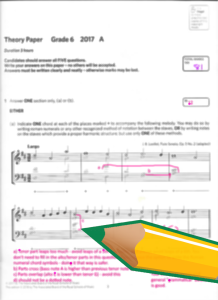
Get a Free Grade 6 Practice Test PDF!