Last Updated on 30 April 2026 by Victoria Williams
To view the note names in US English, hover over the UK terms.
Beaming
What is Beaming in Groups?
To make music easier to read, we normally group these small notes together in complete beats.
To do this, we join the tails together, connecting them into a straight line. We call this line a “beam”- they are beamed notes.
Making Beamed Notes
Notes with one tail have one beam. have two tails so they have two beams, which are drawn quite close together.
Here are some examples of beamed
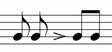
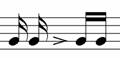
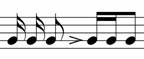
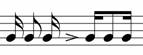
We can also with beams, like this:
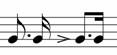
Notice that the lower beam is quite short. This is a cut-off beam.
Cut-off beams should be about as wide as the note-head. They can point in either direction, depending on which side of the dotted note they are on (they point towards the longer note that they make a whole beat with).
Here’s another example of beamed notes which have cut-off beams:
Beaming and Beats
In the time signatures you need to know for Grade 1 Music Theory (2/4, 3/4 and 4/4), the beat is always represented by a time value.
(In other time signatures the beat could be a . However, in this lesson we will assume the beat is always a crotchet.)
In each bar, some notes are given more emphasis than others – this subtle accent is what gives music its feeling of pulse. Beats are categorised as follows:
- Strong beat: this is the strongest accent in the bar and falls right at the beginning of the bar.
- Weak beat: these are the other crotchet beats of the bar. (But, the 3rd beat in 4/4 is stronger than beats 2 and 4).
- Off beat: these are any notes which fall in between the strong and/or weak beats.
The rules for correct beaming depend on the time signature in use. You’ll need to learn the rules for each time signature separately, as well as these general rules:
- The should be joined together to make the obvious.
- Beams never cross over the bar lines.
- The first note of a beamed group must never fall on an off beat, unless it’s preceded by a rest or a dotted note.
Beaming in 2/4 Time
In 2/4 time there are two beats per bar. There is one strong beat, which is the first beat of the bar. The second crotchet beat is the weak beat.
Notes are normally beamed together to make up one crotchet beat. Here are some examples.

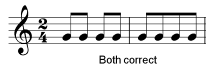
If there are four in a bar, they can all be beamed together.
Beaming in 3/4 Time
In 3/4 time there are three per bar. There is one strong beat, which is the first beat of the bar, followed by two weak beats.

In the above bars, all are correct except the last one. In the last bar, the 4th falls on an off beat.
Here are some examples:

Beaming in 4/4 Time
In 4/4 time there are four beats per bar.
The first beat of the bar is the strong beat. The second and fourth beats are the weak beats. But the third beat is a secondary strong beat.
This means that the first beat of the bar has the strongest accent, the third beat has a slightly weaker accent, and the second and fourth beats receive no accent.

Bar 1 is correct, because the first in each group falls on a strong beat.
Bar 2 is correct, because the first in the first group falls on a weak beat and the first of the second group on a stronger beat. This makes the secondary strong beat obvious.
Bar 3 is incorrect, because the 3rd in the group should have a stronger accent than the first quaver. The importance of the third beat of the bar is hidden.
Groups which contain should normally equal a maximum of one or two .
Here are some examples.

Notice that:
- The first four notes in bar 1 are all beamed together, making a group worth a .
- In bar 2, there is one unbeamed . It can’t be beamed to the next group because that group needs to start on the third beat of the bar, to show the place of the secondary strong beat.
- Bar 3 looks complicated, but it’s not really! The first (strongest) beat is the first rest plus the beamed . Together, they make up one beat. The second (weak) beat is made up of three beamed . The third beat (secondary strong beat) begins on the , and the final beat (weak) is the same as the second beat.
- In bar 3, it would be better not to beam the notes into groups worth a , because it will make it much more difficult to see which of the notes falls on the 2nd or 4th beat.
Beaming and Rests
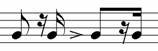
We can include rests inside a group of beamed notes. Rests themselves are never beamed – we simply insert them between the notes. We can change their vertical position on the stave if we need to, to make the music clearer.
Stem Direction – Beaming Two Notes
If you need to join two or more notes together, but some of them have stems which point up and others which point down, which direction do you choose for the beamed group?
For example, let’s say you had to beam together two Ds of different pitches. Should they both have upwards pointing stems, or downwards pointing?
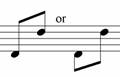
First, work out which note is furthest from the middle line.
In our example above, the bottom D is further away from the middle line than the top D is.
Use the direction of the note which is furthest from the middle line as your guide.
The bottom D has its stem pointing upwards, so that’s the direction we should use with our beaming:

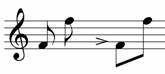
However, if we change the notes to Fs, you will notice that we have to change to stems down, because the top F is further from the middle line than the bottom F:
Angling Beams
Beams can be flat, angled up or angled down. Beaming should follow the general direction of the music, from left to right.
If the music is getting higher, the beam should point upwards; if it’s getting lower it should be downwards. If the pitch of the beamed notes is the same overall, the beam should be flat.
Sometimes you may need to make the stems on some notes extra long, to allow enough space for everything to be seen.

Bars 1-4 are correct.
In bar 4, the stems are extra long on the lower Es, to allow space for the high E.
In bar 5, the beams is flat but the music is rising – this is incorrect.
In bar 6, the music is falling, but the beam is angled upwards, this is incorrect.
In bar 7, the pitch of the first and last notes is the same, so the beam should be flat.
Beaming Exercises
Point your mouse at the stave (tap on mobile devices) to reveal the answers.
Rewrite the following melodies, grouping (beaming) the notes correctly.
1.

2.

3.

4.

5.

6.
